|
||
 |
||
Prepare For The New Golfing Season |
||
|
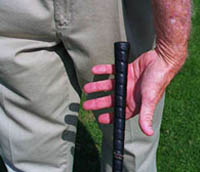
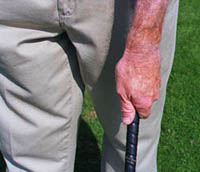
After you dust off your clubs be sure and revitalize your grips by scrubbing them with hot water and a Brillo or SOS soap pad. Rinse them off with hot water and dry with a clean towel. Now lets start out the this season by holding the club correctly. You must hold the club correctly if you are to reach your potential. LEFT HAND: The club should be placed across the bottom of the fingers. When you close your fingers and thumb on the club, make sure the bottom of your index finger and thumb is pointing at your right eye. You will notice when you close your fingers on the club that the club moves slightly across the palm of the hand. |
||
   |
||
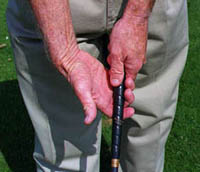
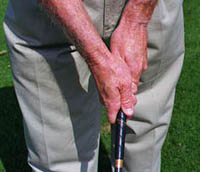
| (RIGHT HAND: The club should be placed in the fingers of the right hand. Upon closing the hand, the thumb of your left hand fits in the palm of your right hand. Make sure the heel of the right hand covers the thumb of the left. Try not to hold the club too tightly. A good indication of this would be if the forearms get tense. Hold the club correctly and you will have made great strides toward better golf. | ||
 |
||
| Try not to hold the club too tightly. A good indication of this would be if the forearms get tense. Hold the club correctly and you will have made great strides toward better golf. | ||
 |
||
A LEVEL SWING IS EFFECTIVE AND ENDURING |
||
I am going to divide the levels into two categories, the address (which includes alignment) and the swing. The address: The head, shoulders, center (the front of your upper
body), hips and knees should be as level as possible. The ball being on
the ground requires you to tilt your shoulders. Do not exaggerate this
tilt. The hands are positioned over the ball. Let the arms hang naturally
creating an angle between the club shaft and the arms. This will help
set the club at the top of the swing. Keep in mind that the position of
your shoulders in the hitting area will be relatively the same as the
position at address. When you take your stance your weight should be evenly
distributed, your feet as wide apart as your shoulders and your knees
slightly flexed. Once you get used to setting up as level as possible
you will find how easy it is to line up the club face and how your good
grip and address compliment each other. The address: The head, shoulders, center (the front of your upper
body), hips and knees should be as level as possible. The ball being on
the ground requires you to tilt your shoulders. Do not exaggerate this
tilt. The hands are positioned over the ball. Let the arms hang naturally
creating an angle between the club shaft and the arms. This will help
set the club at the top of the swing. Keep in mind that the position of
your shoulders in the hitting area will be relatively the same as the
position at address. When you take your stance your weight should be evenly
distributed, your feet as wide apart as your shoulders and your knees
slightly flexed. Once you get used to setting up as level as possible
you will find how easy it is to line up the club face and how your good
grip and address compliment each other.The Swing: Throughout the swing you must keep the hips, shoulders and head as level as possible. Keeping your knees the same flex and the same distance apart is the only way these levels can be maintained. The center of the swing must stay level and turn away from the ball transferring its weight to the inside of the right leg. Your head should remain steady although a slight rotation to the right is acceptable. This will position you behind the ball. Now you are poised to move forward. In the forward swing the center will move through the ball and past the ball to a level position facing the target. The head remains steady until contact is made. Then it must rotate and move forward with the center to maintain your levels and finish the swing properly. A simple way to get this feel is to watch the flight of the ball after you hit it. Your weight at the finish will be off the right side with all the spikes of your right shoe showing. Your center will be facing the target. Your back will be straight, your knees, hips and shoulders level. 
 |
||
A SMOOTH TRANSITION |
||
| The
start of the forward swing needs to be just as smooth as the beginning
of the backswing. The swing never totally stops at the top of the backswing
but one of the most common mistakes of all golfers is to rush the transition.
Starting the backswing unusually slow is not the answer as the tendency
then is to try to catch up on the forward swing. The best way to accomplish a smooth, overall swing is to picture the tempo of the entire swing at the address as opposed to trying to picture a backswing and a forward swing. This will help you immensely towards a smooth transition. |
||
ADDRESSING THE BALL |
||
| When addressing the ball it is a mistake to plant your feet first and then try to correct your alignment. A good habit is to look at your target while placing your feet. You will naturally line up slightly to the left of the target (for right handers) which allows your center and right side to get through the shot. | ||
ARE YOU HOOKING THE BALL? |
||
| The
most common causes of hooking (too much right to left curve on the ball)
are a closed club face at the top of the backswing or a bad grip or both.
Usually a closed face at the top of the swing is when the back of the
right hand is facing the ground when you grip the club. You need to cover
the thumb of the left hand. That will keep your right hand working with
the club face. The left hand turned too far to the right can also close
the face. The club can also get closed at the top of the swing by permitting
the left wrist to collapse into a reverse cup position. The good news about people who hook the ball is they have rotation in their swing. This along with a good grip and good center (the upper front of your torso) movement will go a long way toward good shots. |
||
ARE YOU SLICING THE BALL? |
||
The most common explanation of a sliced shot (the ball curving too much from left to right) is that the ball is being struck from the outside to the inside of the target line. However, you can just as easily slice the ball from the inside to the outside which could be worse as the ball starts to the right and then slices. Most of the time the reason the ball slices is because there is no rotation or crossover (the left arm rotating with the right arm crossing the left throughout the hitting area). The pros have a tendency to hook more than slice because they all have a rotation in their swing. Left to right players (faders, which means slightly left to right) have to hold the rotation in the hitting area. In order to develop a rotation in your swing you must go back to my fundamentals:
If you keep the elbows together in the hitting area and keep the center moving, the rotation will automatically happen. A bad grip ruins everything. |
||
ARE YOU TOPPING THE BALL? |
||
| If you are topping the ball, don’t follow your friend’s advice and "keep your head down." Keeping your head down could be contributing to the topped shot. You must keep your knees and head at the same level and your elbows together throughout the swing. To keep your head level you must keep your center (the upper front of your torso) moving in the forward swing, and to keep your center moving through the hitting area and to the finish you must let your head move with the center. Keeping your head down too long stops the center preventing the arms to continue through the shot. |
||
ESTABLISH YOUR TEMPO |
||
You must have a smooth, rhythmic tempo in order to get the most of your swing. You notice I did not say slow or fast, but smooth and rhythmic. Let me show you the best way to establish a good tempo. For our purposes, tempo is the length of time the swing takes from start to finish. Speed is how fast the club swings. Establish your tempo with a #5 iron as this is an average length club. Make sure you warm up first. Now you should try to swing all your clubs the same tempo you used with the #5 iron (the same length of time from start to finish). Consequently the #6 iron will swing slower than the #5 and progressively get slower as the as the club gets shorter. Conversely the longer clubs will swing progressively faster. The speed of the club is dictated by the length of the club and is not your concern. The same tempo is your concern. |
||
FAIRWAY BUNKER SHOTS |
||
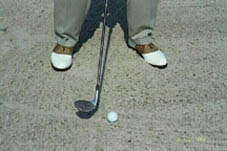
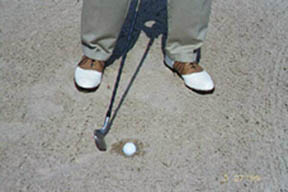
When playing a shot from the fairway bunker make sure of the following;
If you have a buried or otherwise bad lie the only thing you can do is close the face on a lofted club, play the ball back in your stance and get the ball into play. |
||
KEEP YOUR HEAD DOWN? |
||
Everyone who has ever played golf has been told to keep their head down. Usually it’s because the person giving the tip doesn’t know what else to say. The truth of the mater is trying to keep your head down too long restricts your forward swing. Or, more accurately, it destroys it. The head needs to stay level and not change its position during the backswing. However, in the forward swing it should move with the center (the front of your torso) as you move through and past the hitting area. This will help you complete your follow through and finish in a balanced position facing the target. |
||
THE EVER DREADED BUNKERSHOT |
||
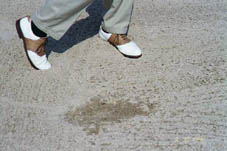
There are various techniques for getting out of sand but using the same principle as the flop shot is very effective. The main difference is that you hit the sand first, not the ball. If you were to take a divot with a practice swing (which is not permitted during play) the ball would have been in the center of that divot. Just like the flop shot let the club do the work and keep the arms and center moving to a follow through. If you want to get the ball up faster hinge your wrists in the backswing. A good rule of thumb for soft sand and good lies is to open your stance and your club face. For bad lies, wet or hard sand square your stance and close your club face. Remember hit the sand first and follow through keeping your arms and center moving. Keep in mind it is against the rules to ground the club in a hazard and test the depth of the sand. You are permitted to take a fair stance so moving your feet to get a balanced position is permissable.
|
||
PUTT FOR SCORE |
||
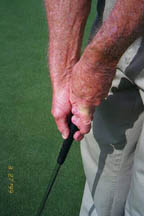 In
terms of scoring, putting is the most important part of the game. To be
a good putter takes a good technique, concentration and lots of practice.
Many players lack confidence in putting. In some cases they actually fear
this part of the game taking away all the enjoyment. Positive thinking
certainly helps your confidence but good technique and a lot of practice
is a must. You'd be surprised how confident you can get when you know
what you are doing. In
terms of scoring, putting is the most important part of the game. To be
a good putter takes a good technique, concentration and lots of practice.
Many players lack confidence in putting. In some cases they actually fear
this part of the game taking away all the enjoyment. Positive thinking
certainly helps your confidence but good technique and a lot of practice
is a must. You'd be surprised how confident you can get when you know
what you are doing.The reverse overlap grip is the most common grip. In the address it is best 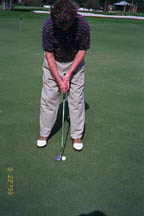 to line up your feet and shoulders as squarely as possible keeping your
head over the ball. The ball should be positioned between the left heel
and the center of your stance with your hands also over the ball.
to line up your feet and shoulders as squarely as possible keeping your
head over the ball. The ball should be positioned between the left heel
and the center of your stance with your hands also over the ball.There are different techniques in putting; the most important thing is to feel the stroke in your shoulders and arms. In doing so you should subsequently avoid "flipping" your hands and wrists. Keep your head, body and knees absolutely still. The only thing that moves is the arms and shoulders. 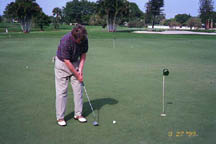 I can give you a good putting technique but I cannot tell you how hard
to hit the ball. That comes with practice. The longer the stroke or the
faster the stroke the harder the ball will be hit. Three important things
to remember in distance is to control your tempo, follow through at least
the same distance as you take the club back and always accelerate through
the ball.
I can give you a good putting technique but I cannot tell you how hard
to hit the ball. That comes with practice. The longer the stroke or the
faster the stroke the harder the ball will be hit. Three important things
to remember in distance is to control your tempo, follow through at least
the same distance as you take the club back and always accelerate through
the ball. |
||
TEMPO-PUTTING |
||
|
I like to use the same tempo for every length putt. That is, take the same length of time for every putting stroke. Two things dictate how far the putt travels:
Establish your tempo with about a six foot putt (the length of time the stroke takes from start to finish). Using a metronome is the best way to practice this. However, you still must mentally establish your tempo. You will find with a little practice the length and speed of the putt automatically change using the same tempo. This is a very positive approach to putting. Try it, you may surprise yourself. |
||
THE BACK SWING |
||
The
key to the back swing is to turn your center (front part of your
Losing your balance
to the outside of your right leg and allowing the
The opposite is
just as bad or worse. That is leaving your weight on the |
||
UPHILL AND DOWNHILL LIES IN BUNKERS |
||
Uphill
and downhill lies add to the difficulty of bunker shots. Here are some
suggestions that will help you negotiate these Uphill: Downhill: |
||
THE FLOP SHOT |
||
|
The flop shot is
very valuable when you need to carry the ball over
Because the swing is so slow and relaxed with a big hinge in the wrists the club goes back farther than you might imagine. This shot requires a very slow rhythmic tempo while you keep your arms and center moving through the ball. |
||
   |
||
HOW TO GENERATE POWER |
||
|
||
 The
faster you can move the body in the forward swing without sacrificing
a smooth rhythmic tempo the more club head speed you will develop. The
left arm will rotate and the right arm will extend and cross over the
left, just as a home run hitter's arms react. The
faster you can move the body in the forward swing without sacrificing
a smooth rhythmic tempo the more club head speed you will develop. The
left arm will rotate and the right arm will extend and cross over the
left, just as a home run hitter's arms react. |
||
 It
is imperative that you keep the body moving to the finish. Otherwise the
arms and hands will deliver prematurely. It
is imperative that you keep the body moving to the finish. Otherwise the
arms and hands will deliver prematurely. |
||
|
To order my instructional book, video or both refer to Roland Stafford’s Golf Course. | |
|
|
||
|
Home
| Roland Stafford Golf Schools
| Our Golf Instructors
| Location & Rates
| Golf Teaching Method |
||

|
||
 torso)
behind the ball without changing your head position and without losing
your balance on the right leg.
torso)
behind the ball without changing your head position and without losing
your balance on the right leg. body,
including your head, to move laterally off the ball is known as a sway.
body,
including your head, to move laterally off the ball is known as a sway.
 left side, never turning your center behind the ball, and creating the
position known as a reverse pivot.
left side, never turning your center behind the ball, and creating the
position known as a reverse pivot. lies.
lies. to get the ball lofted.